Friday, February 8, 2013

Imaging acute ischemic stroke patients' brains did not lead to improved outcomes

Imaging acute ischemic stroke patients' brains did not lead to improved outcomes [ Back to EurekAlert! ] Public release date: 8-Feb-2013
[ | E-mail | Share Share ]

Contact: Kathryn DeMott
nindspressteam@ninds.nih.gov
301-496-5751
NIH/National Institute of Neurological Disorders and Stroke

NIH-funded study assessed benefits of targeted clot removal based on brain status

The use of advanced imaging shortly after the onset of acute stroke failed to identify a subgroup of patients who could benefit from a clot-removal procedure, a study has found.

The randomized controlled trial known as Mechanical Retrieval and Recanalization of Stroke Clots Using Embolectomy (MR RESCUE) was funded by the National Institute of Neurological Disorders and Stroke (NINDS), part of the National Institutes of Health, and was published online Feb. 8 in the New England Journal of Medicine.

In patients with ischemic stroke (caused by a blockage in an artery), brain cells deprived of blood die within minutes to hours. Rapidly opening the artery can halt brain cell death. Intravenous tissue plasminogen activator (t-PA), a drug that dissolves clots has been shown to improve outcomes in such stroke patients. However intravenous t-PA is not effective in many patients with large clots blocking the major brain arteries that cause the most devastating strokes. MR RESCUE investigators tested an invasive clot removal strategy designed to remove clots from these large arteries. Patients in the study were enrolled at 22 centers in the United States within approximately 5.5 hours of their stroke onset. Their ability to function independently was assessed at 90 days.

All MR-RESCUE patients underwent emergency computed tomography (CT) or magnetic resonance (MRI) perfusion imaging to identify regions of the brain with decreased blood flow, as well as regions that could not be salvaged.

The investigators hypothesized that patients in whom the scan suggested that less than 70 percent of the brain with decreased blood flow had already died would benefit from the clot-removal procedures. Based on the imaging results, the 118 study patients were randomly assigned to receive a clot-removal procedure within eight hours of symptom onset (64 patients) or standard therapy (54 patients) according to medical protocols. The procedure involves threading a special catheter through an artery in the groin up to the site of a clot in a brain artery, then removing the blockage.

"Despite a lack of evidence showing that these clot-removal devices improve outcomes, they are already widely used in patients who are not able to get to the hospital in time to receive t-PA," said Walter J. Koroshetz, M.D., deputy director of NINDS. "Though some patients have had dramatic improvements with clot removal, it has not been shown effective in this or another larger study, the Interventional Management of Stroke (IMS III), which was halted early because it did not find the procedure to be of significant benefit."

"The majority of patients were not eligible to receive intravenous t-PA, the only drug approved by the Food and Drug Administration for the treatment of stroke, because they arrived at the hospital too late for t-PA to be effective," said one of the primary investigators, Chelsea Kidwell, M.D., of Georgetown University Medical Center in Washington, D.C. As brain cells are dying continuously in the minutes and hours after stroke, the earlier that treatment is given the greater the likelihood of a good outcome for the patient.

The patients with the presumed favorable imaging findings had the same level of disability at 90 days whether or not they had undergone the clot-removal procedure or had received standard therapy. The researchers hypothesized that the lack of a treatment effect may reflect the fact that these patients had enough blood flow to the brain from secondary sources to support the brain tissue until spontaneous reperfusion occurred. Patients without the favorable imaging findings did not benefit from the clot-removal procedure.

However, the results of MR RESCUE are not consistent with the conclusions of a separate NINDS-funded observational study called DEFUSE-2 that suggested that a slightly different brain imaging strategy could predict patients who benefited from the clot-removal procedure.

In addition to other imaging techniques "it's possible that newer intra-arterial devices that were not available when the study started could improve functional outcomes," said Scott Janis, Ph.D., program director, NINDS. "But an important message from MR RESCUE is that those newer devices still need to go head to head with standard therapy."

"Advances in neuroimaging are promising and may someday help to identify who will benefit from a device-based approach. But the MR RESCUE results show that more work needs to be done," Dr. Koroshetz said.

Additional information from the MR RESCUE study will be presented at the International Stroke Conference in Hawaii, Feb. 6-8, 2013.

###

Funding for MR RESCUE was provided by an NINDS grant (P50 NS044378). Concentric Medical, Inc. (Mountain View, CA) provided study catheters and devices from study start until August, 2007; thereafter, costs for all study catheters and devices have been covered by study funds or third party payers.

References: Kidwell C, Jahan R, Gornbein J, et al. "A trial of imaging selection and endovascular treatment for ischemic stroke intervention," N. Engl. J. Med. 2013. DOI: 10.1056/NEJMoa1212793. NINDS is the nation's leading funder of research on the brain and nervous system. The NINDS mission is to reduce the burden of neurological disease a burden borne by every age group, by every segment of society, by people all over the world.

About the National Institutes of Health (NIH): NIH, the nation's medical research agency, includes 27 Institutes and Centers and is a component of the U.S. Department of Health and Human Services. NIH is the primary federal agency conducting and supporting basic, clinical, and translational medical research, and is investigating the causes, treatments, and cures for both common and rare diseases. For more information about NIH and its programs, visit http://www.nih.gov.

MR RESCUE Investigators

Georgetown University Medical Center, Washington, D.C.: Chelsea S. Kidwell, M.D. University of California, Los Angeles, CA: Jeffry R. Alger, Ph.D.; Jeffrey Gornbein, Dr.P.H.; Judy Guzy, R.N.; Reza Jahan, M.D.; Val Nenov, Ph.D.; Jeffrey L. Saver, M.D.; Sidney Starkman, M.D. Kaiser Permanente, Los Angeles, CA: Zahra Ajani, M.D.; Lei Feng, M.D., Ph.D. University of California, San Diego, CA: Brett C. Meyer, M.D.; Scott Olson, M.D. Harvard Medical School, Massachusetts General Hospital, Boston, MA: Lee H. Schwamm, M.D.; Albert J. Yoo, M.D. Columbia University, College of Physicians & Surgeons, New York, NY: Randolph S. Marshall, M.D., M.S.; Philip M. Meyers, M.D. University of Miami, Jackson Memorial Hospital, Miami, FL: Dileep R. Yavagal, M.D. University of Virginia, Charlottesville, VA: Max Wintermark, M.D.


[ Back to EurekAlert! ] [ | E-mail | Share Share ]

?


AAAS and EurekAlert! are not responsible for the accuracy of news releases posted to EurekAlert! by contributing institutions or for the use of any information through the EurekAlert! system.


Imaging acute ischemic stroke patients' brains did not lead to improved outcomes [ Back to EurekAlert! ] Public release date: 8-Feb-2013
[ | E-mail | Share Share ]

Contact: Kathryn DeMott
nindspressteam@ninds.nih.gov
301-496-5751
NIH/National Institute of Neurological Disorders and Stroke

NIH-funded study assessed benefits of targeted clot removal based on brain status

The use of advanced imaging shortly after the onset of acute stroke failed to identify a subgroup of patients who could benefit from a clot-removal procedure, a study has found.

The randomized controlled trial known as Mechanical Retrieval and Recanalization of Stroke Clots Using Embolectomy (MR RESCUE) was funded by the National Institute of Neurological Disorders and Stroke (NINDS), part of the National Institutes of Health, and was published online Feb. 8 in the New England Journal of Medicine.

In patients with ischemic stroke (caused by a blockage in an artery), brain cells deprived of blood die within minutes to hours. Rapidly opening the artery can halt brain cell death. Intravenous tissue plasminogen activator (t-PA), a drug that dissolves clots has been shown to improve outcomes in such stroke patients. However intravenous t-PA is not effective in many patients with large clots blocking the major brain arteries that cause the most devastating strokes. MR RESCUE investigators tested an invasive clot removal strategy designed to remove clots from these large arteries. Patients in the study were enrolled at 22 centers in the United States within approximately 5.5 hours of their stroke onset. Their ability to function independently was assessed at 90 days.

All MR-RESCUE patients underwent emergency computed tomography (CT) or magnetic resonance (MRI) perfusion imaging to identify regions of the brain with decreased blood flow, as well as regions that could not be salvaged.

The investigators hypothesized that patients in whom the scan suggested that less than 70 percent of the brain with decreased blood flow had already died would benefit from the clot-removal procedures. Based on the imaging results, the 118 study patients were randomly assigned to receive a clot-removal procedure within eight hours of symptom onset (64 patients) or standard therapy (54 patients) according to medical protocols. The procedure involves threading a special catheter through an artery in the groin up to the site of a clot in a brain artery, then removing the blockage.

"Despite a lack of evidence showing that these clot-removal devices improve outcomes, they are already widely used in patients who are not able to get to the hospital in time to receive t-PA," said Walter J. Koroshetz, M.D., deputy director of NINDS. "Though some patients have had dramatic improvements with clot removal, it has not been shown effective in this or another larger study, the Interventional Management of Stroke (IMS III), which was halted early because it did not find the procedure to be of significant benefit."

"The majority of patients were not eligible to receive intravenous t-PA, the only drug approved by the Food and Drug Administration for the treatment of stroke, because they arrived at the hospital too late for t-PA to be effective," said one of the primary investigators, Chelsea Kidwell, M.D., of Georgetown University Medical Center in Washington, D.C. As brain cells are dying continuously in the minutes and hours after stroke, the earlier that treatment is given the greater the likelihood of a good outcome for the patient.

The patients with the presumed favorable imaging findings had the same level of disability at 90 days whether or not they had undergone the clot-removal procedure or had received standard therapy. The researchers hypothesized that the lack of a treatment effect may reflect the fact that these patients had enough blood flow to the brain from secondary sources to support the brain tissue until spontaneous reperfusion occurred. Patients without the favorable imaging findings did not benefit from the clot-removal procedure.

However, the results of MR RESCUE are not consistent with the conclusions of a separate NINDS-funded observational study called DEFUSE-2 that suggested that a slightly different brain imaging strategy could predict patients who benefited from the clot-removal procedure.

In addition to other imaging techniques "it's possible that newer intra-arterial devices that were not available when the study started could improve functional outcomes," said Scott Janis, Ph.D., program director, NINDS. "But an important message from MR RESCUE is that those newer devices still need to go head to head with standard therapy."

"Advances in neuroimaging are promising and may someday help to identify who will benefit from a device-based approach. But the MR RESCUE results show that more work needs to be done," Dr. Koroshetz said.

Additional information from the MR RESCUE study will be presented at the International Stroke Conference in Hawaii, Feb. 6-8, 2013.

###

Funding for MR RESCUE was provided by an NINDS grant (P50 NS044378). Concentric Medical, Inc. (Mountain View, CA) provided study catheters and devices from study start until August, 2007; thereafter, costs for all study catheters and devices have been covered by study funds or third party payers.

References: Kidwell C, Jahan R, Gornbein J, et al. "A trial of imaging selection and endovascular treatment for ischemic stroke intervention," N. Engl. J. Med. 2013. DOI: 10.1056/NEJMoa1212793. NINDS is the nation's leading funder of research on the brain and nervous system. The NINDS mission is to reduce the burden of neurological disease a burden borne by every age group, by every segment of society, by people all over the world.

About the National Institutes of Health (NIH): NIH, the nation's medical research agency, includes 27 Institutes and Centers and is a component of the U.S. Department of Health and Human Services. NIH is the primary federal agency conducting and supporting basic, clinical, and translational medical research, and is investigating the causes, treatments, and cures for both common and rare diseases. For more information about NIH and its programs, visit http://www.nih.gov.

MR RESCUE Investigators

Georgetown University Medical Center, Washington, D.C.: Chelsea S. Kidwell, M.D. University of California, Los Angeles, CA: Jeffry R. Alger, Ph.D.; Jeffrey Gornbein, Dr.P.H.; Judy Guzy, R.N.; Reza Jahan, M.D.; Val Nenov, Ph.D.; Jeffrey L. Saver, M.D.; Sidney Starkman, M.D. Kaiser Permanente, Los Angeles, CA: Zahra Ajani, M.D.; Lei Feng, M.D., Ph.D. University of California, San Diego, CA: Brett C. Meyer, M.D.; Scott Olson, M.D. Harvard Medical School, Massachusetts General Hospital, Boston, MA: Lee H. Schwamm, M.D.; Albert J. Yoo, M.D. Columbia University, College of Physicians & Surgeons, New York, NY: Randolph S. Marshall, M.D., M.S.; Philip M. Meyers, M.D. University of Miami, Jackson Memorial Hospital, Miami, FL: Dileep R. Yavagal, M.D. University of Virginia, Charlottesville, VA: Max Wintermark, M.D.


[ Back to EurekAlert! ] [ | E-mail | Share Share ]

?


AAAS and EurekAlert! are not responsible for the accuracy of news releases posted to EurekAlert! by contributing institutions or for the use of any information through the EurekAlert! system.


Source: http://www.eurekalert.org/pub_releases/2013-02/nion-iai020813.php

Alison Pill Sam Bacile sprint britney spears At&t Wireless 9/11 Jerry Lawler

Pick the right time to insert pauses in presentations ? Business ...

business woman giving speechNervous public speakers tend to rush. They mumble, mutter and stammer their way through their speeches, yearning to finish and get off the stage.

Yet there?s a simple technique that calms anxious presenters: the well-timed pause.

Pauses are like adding commas to spoken text. They enable you to regroup mentally while letting audiences follow your remarks more easily.

Use these guidelines to decide when to pause:

? Transitioning within sentences. When using words such as ?but,? ?because? and ?however,? pause to connect the full sentence. Example: Jim has fine sales skills; (pause) however, his administrative skills need to improve.

? Listing many items. When running down a series of action steps, reminders or statistics, pause before advancing to the next one. Otherwise, you might string them together and make it hard for others to distinguish between each item.

? Opening prepositions. For sentences that begin with a preposition, pause before you complete the sentence. Exam??ple: Despite our best efforts, (pause) the deal fell through. This also applies when you start a sentence with an adverb. Example: Ideally, (pause) we?d file the report this week. ?

? Addressing a large audience. If you?re speaking outdoors or in a high-ceiling auditorium or other expansive space, the sound of your voice may need more time to fill the area. Slow your tempo and pause more frequently between sentences to accommodate the acoustics.

? Adapted from How to Say It With Your Voice, Jeffrey Jacobi, Prentice Hall Press.

Like what you've read? ...Republish it and share great business tips!

Attention: Readers, Publishers, Editors, Bloggers, Media, Webmasters and more...

We believe great content should be read and passed around. After all, knowledge IS power. And good business can become great with the right information at their fingertips. If you'd like to share any of the insightful articles on BusinessManagementDaily.com, you may republish or syndicate it without charge.

The only thing we ask is that you keep the article exactly as it was written and formatted. You also need to include an attribution statement and link to the article.

" This information is proudly provided by Business Management Daily.com: http://www.businessmanagementdaily.com/34350/pick-the-right-time-to-insert-pauses-in-presentations "

Source: http://www.businessmanagementdaily.com/34350/pick-the-right-time-to-insert-pauses

Joe Webb Fiesta Bowl Jeanie Buss NFL playoff schedule 2013 biggest loser Bronson Pelletier andy reid

Thursday, February 7, 2013

China says extremely concerned after latest North Korea threats

BEIJING (Reuters) - China expressed serious concern on Wednesday after North Korea stepped up its bellicose rhetoric and threatened to go beyond a third nuclear test in response to what it sees as "hostile" sanctions imposed after a December rocket launch.

"China is extremely concerned by the way things are going. We oppose any behavior which may exacerbate the situation and any acts which are not beneficial towards the denuclearization of the Korean peninsula," said Foreign Ministry spokeswoman Hua Chunying.

"We call on all the relevant sides to remain calm and exercise restraint and earnestly work hard to maintain peace and stability in the Korean peninsula," she told a daily news briefing.

China is the North's sole remaining major diplomatic and economic benefactor but has been showing sings of exasperation with its isolated neighbor.

One of China's most widely read newspapers, the tabloid Global Times published by Communist Party mouthpiece the People's Daily, said China should take a tough line and inform North Korean leaders of the consequences of their actions.

"If North Korea insists on a third nuclear test despite attempts to dissuade it, it must pay a heavy price," it said in an editorial in both its Chinese and English-language issues.

The newspaper said China should cut its help if North Korea went ahead with the nuclear test. In 2009, China reportedly cut fuel supplies to North Korea after a nuclear test, although it was impossible to verify the reports.

"The assistance it will be able to receive from China should be reduced. The Chinese government should make this clear beforehand to shatter any illusions Pyongyang may have," the Global Times said.

While the stridently nationalist newspaper is not considered an official mouthpiece of the Chinese government, it is nonetheless an influential publication.

North Korea has vowed to conduct more rocket and nuclear tests in response to a U.N. censure for its launch of a long-range missile launch in December. On Tuesday, it vowed "stronger" but unspecified actions in addition to the test.

U.S.-backed South Korea and others who have been closely observing activities at the North's known nuclear test grounds believe it is technically ready for a nuclear test and is awaiting the final word from supreme leader Kim Jong-un.

The Chinese spokeswoman reiterated China's wished to see a nuclear-weapons-free Korean peninsula.

NORTH HAS STRUCK BEFORE

In 2010, North Korea was blamed for sinking a South Korean naval vessel. It also shelled a South Korean island in the same year, killing civilians.

The North, which frequently aims fiery rhetoric at South Korea and the United States, did not spell out the actions it would take in its comments on Tuesday.

It is not capable of staging a military strike on the United States, although South Korea is in range of its artillery and missiles and Japan of its missiles.

"The DPRK (Democratic Peoples Republic of Korea, or North Korea) has drawn a final conclusion that it will have to take a measure stronger than a nuclear test to cope with the hostile forces' nuclear-war moves that have become ever more undisguised," the North's KCNA state news agency said.

New U.S. Secretary of State John Kerry discussed North Korea in what he said were "remarkably similar" telephone conversations with his counterparts from Japan, South Korea and China, State Department spokeswoman Victoria Nuland said.

U.N. resolutions ban North Korea from developing missile or nuclear technology after its nuclear tests in 2006 and 2009.

North Korea says that it has the sovereign right to launch rockets for peaceful purposes, even though the multiple U.N. resolutions make this illegal under international law.

The North has in the past said its nuclear program was for peaceful purposes but has more recently boasted of becoming a nuclear weapons state.

(Reporting by Koh Gui Qing and Ben Blanchard)

Source: http://news.yahoo.com/china-says-extremely-concerned-latest-north-korea-threats-101838246.html

dickclark gavin degraw gavin degraw alec time 100 bob beckel anna paquin

Wednesday, February 6, 2013

Divers Alert Network Announces Retirement of Dan Orr

(DiverWire) Divers Alert Network (DAN) announced today that well-known DAN representative and industry ambassador Dan Orr has retired from his position as President of DAN Inc.? Orr, who has been with the DAN organization for the last two decades, is a well-respected and recognized fixture at industry and consumer events throughout the world.

Dan Orr?s passion for scuba diver safety has grown through his tenure with DAN that has taken him to virtually every corner of the globe.? Orr, can often be seen engaging scuba divers at various events throughout the country.? He is an invited speaker at diving medical and safety seminars around the world and often speaks to local scuba diving clubs and local scuba retail outlets.
Having held multiple positions within the DAN organization, Orr is best recognized for developing the DAN Oxygen Program that has become the worldwide standard in the first aid for diving emergencies.? By working with instructors and local dive stores and local dive stores across the country, Orr helped build a network of DAN instructors and instructor-trainers that allowed this important initiative to quickly spread throughout the global diving community.? Orr has spent his career at DAN promoting DAN?s mission of dive safety.

?Dan Orr?s commitment to the recreational scuba industry is unmatched.? His spirit, dedication and expertise have helped make DAN the diving industry?s leading safety organization.? For that, every DAN member past and present can thank Dan Orr,? said William Ziefle, President and CEO of DAN Inc.? ?We appreciate everything Dan Orr has done for DAN and the dive industry and wish them well in their future endeavors.?

Ziefle added that Dan Orr has been named President Emeritus of the DAN Foundation and will serve DAN in an official capacity until his retirement in August 2013.

Among the many awards and accolades that Dan Orr has received over the years, the latest and most prestigious was the DEMA Reaching Out Award which was presented to him last Fall.? A published author of numerous books, training programs and presentations, Orr was elected into the Hall of Fame for Disabled Divers in 2010, is a recipient of the NOGI Award in Sports/Education, the Wyland Icon Award, Beneath the Sea?s Diver of the Year, the Our World Underwater Award, the Leonard Greenstone Diving Safety Award, and is one of the inaugural Platinum Pro 5000 honorees by Scuba Schools International.

? Material posted and distributed on DiverWire.com is protected by International Copyright law. Any UNAUTHORIZED reproduction, re-distribution or abuse of this information is strictly prohibited. DiveNewswire Networks LLC - 2013

Source: http://www.diverwire.com/post/scuba-training-news/divers-alert-network-announces-retirement-of-dan-orr/

instagram mark sanchez christina aguilera Mayan End Of The World Olivia Black the voice World Ending 2012

Americans are wasting billions sitting in traffic

While you're cursing the traffic you're idling in on your way to work, not only time is being wasted, a new study released Tuesday shows.

An annual study of national driving patterns reveals that Americans spent 5.5 billion additional hours sitting in traffic in 2011.

Traffic jams on the way to or from work ate, on average, 38 hours of commuters' lives that year, up from 34 hours the year before, the study found. That's nearly four hours longer than the average workweek.

The Texas A&M Transportation Institute's report found Americans are adapting to road congestion by allowing, on average, an hour to make a trip that would take 20 minutes without traffic. The Urban Mobility Report also says clogged roads cost Americans $121 billion in time and fuel in 2011.

The report is one of the key tools used by experts to solve traffic problems. But the institute advises that every community has unique challenges and require different, multi-faceted approaches to solving congestion.

Washington, D.C., where drivers spend 67 hours per year in traffic, was the most congested urban area for the second consecutive year, followed by Los Angeles, San Francisco, New York and Boston, the researchers found.

Traffic congestion reached its peak in 2005, when drivers spent an average of 43 hours a year in traffic.

"Prior to the economy slowing, congestion levels were much higher, and we really expect to see the conditions of congestion ... really go up as the economy improves," Bill Eisele, a TTI researcher and the co-author of the report, told Reuters.

The reduction in congestion had more to do with job losses than any coordinated effort by cities to move to alternate forms of transportation, Eisele said.

He said that peak congestion nationwide was on Friday from 6 p.m. to 7 p.m. while more than one-third of all delays occurred in the middle of the day.

The report found that 60 percent of delays occurred on streets and 40 percent on highways.

The congestion brought with it a hefty price tag: Traffic congestion cost American motorists $818 each in 2011 - more than is spent on Christmas presents - from wasted gasoline to lost productivity to increased vehicle maintenance costs, the study found.

Drivers on average wasted 19 gallons of fuel in 2011, the report found.

Clearing vehicle crash sites more quickly, better synchronizing of traffic signals and improved notification of traffic delays to motorists would all ease congestion, Eisele said

"As this report demonstrates, travelers are paying the price for this inadequate response," Eisele said.

The Associated Press and Reuters contributed to this report.

Source: http://www.nbcnews.com/business/economywatch/america-wasting-billions-sitting-soul-crushing-traffic-1B8251555

NBA draft 2012 alicia sacramone Don Grady ann curry euro 2012 Colorado Springs pga tour

Tuesday, February 5, 2013

The Baby Saga ? Success! ? Not such a Yummy Mummy's Blog

It?s been a while since I posted about what was happening in the whole baby saga epic. In November I wasted too much money (and tears) on tests when I was 2 weeks late. In December I decided I wasn?t going to test until I had missed 2 periods. I almost made it?

I think I knew I was going to be pregnant in December. My sister and her family was coming home from Australia for 3 weeks, we had a few nights out booked in and I wasn?t working for most of it. It was fate! Or Sod?s Law, whatever. I have to say I went off alcohol quite a bit from mid December. At our work?s conference (and Christmas party), I stayed pretty sober, interspersing wine with water and diet coke and going to bed at a reasonable hour (I did have a 5 hour drive home though, but this hasn?t bothered me before!) Even on Christmas Day and Boxing Day I wasn?t that bothered about drinking. Not that it repelled me or anything, I just didn?t fancy it. Wish I felt that way about chocolate.

My parent?s neighbour said a few weeks later that I just looked pregnant at Christmas but he didn?t say anything to me! Think I would have been freaked out as we didn?t know then!

I finally admitted I was almost a month late the day after Boxing Day. My Mum & Dad (unrelated to this) offered to have Sam for the night and Craig & I went to watch Reacher at the cinema. On the way home I grabbed a test from Tesco & not telling Craig, did it. Immediate, no doubt, clear as day positive. Woo hoo! We were thrilled, anxious but thrilled. As I had been in denial for much of the month when I worked out my dates I was 8.5 weeks. When I was pregnant with Sam we found out at 3 weeks, had a bleed at 6 weeks, was signed off work and scanned twice by 8 weeks so I was glad not to have that kind of drama this time.

We were going to wait a couple of days before telling our families but the next day we were going to Thomas Land with my parents, sister & family. I managed to keep it a secret all day (avoiding roller coasters and wine ? yes wine at a theme park! Genius!) until we went for a curry at my parents. I ended up telling them and within a day both our families know. They were naturally thrilled for us, they know how much this pregnancy means to us.

I think we might have made a teeny mistake telling Sam ? he was?desperate to know when the baby will arrive ?How many more minutes Mummy?? but as the weeks have gone on he?s chilled out a bit. He does like looking at my apps and seeing how big the baby is which I think is just lovely. If he has a brother he thinks he should be called Luke and if it?s a sister he?ll call it Thomas! Grumpyish Mum?s eldest, Louis made me laugh when he came round for tea a couple of weeks ago. He thinks if it?s a girl it should be Rose (funnily enough on my short list anyway!) and if it?s a boy, Louis-Sam. Can?t fault him. :)

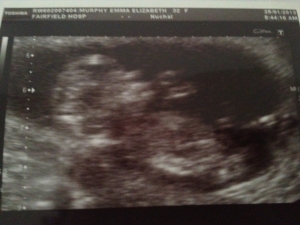
I had my 12 weeks scan?a couple of weeks ago?and everything is a-ok. Baby looks fine, likes to do backflips and is even more active than Sam was at that stage. I have an appointment?this week with a consultant about trying for a natural birth (if you don?t know, I had an emergency c section last time which floored me emotionally & physically and I do not want to repeat that). As long as I stay fit, healthy and my blood pressure doesn?t leap up like last time then I have a 75% chance of a natural delivery, this thrills me. I am already downloading hypnobirthing info, gathering stats on VBACs (Vaginal Birth After Caesarean), finding natural ways to keep my blood pressure down and reading positive birth stories. I know my body can do this, I just have to stay strong and well.

And that takes us up to now! The constant nausea and exhaustion that plagued me so much over the past few weeks seems to be lifting slightly. The tiredness is lingering a bit longer than I?d like actually (last night I fell asleep on the sofa at 6.45pm, woke up at 8.15pm & went to bed at 9.30!) I?m?14 weeks pregnantnow &?very much looking forward to the ?glowing? part of the 2nd trimester! My family are being wonderful ? Craig is cooking and cleaning loads to help me out (to be fair as I?m napping pretty much every day after work, if he didn?t do it no one would!), Sam tells me to sit down to let the baby rest and my parents have had looked after Sam the last couple of Fridays and let me lie in at the weekend. Very much needed after 6am starts through the week!

Despite the tiredness I am so, so happy to finally be pregnant. I think we?re both a little worried about how we?ll cope with 2 children in a 2 bedroom house, the childcare costs, them being over 5 years apart, having this baby in the summer holidays when Sam is home, how I?ll manage 2 children when Craig is on nights and asleep upstairs! I?m of course worried about the birth, being able to breastfeed as successfully as I did last time, regressing 5 years to sleepless nights, etc etc. All fairly standard worries I think! We know what we?re doing, we want this baby very much and we?re so lucky to have conceived it finally (first month on Clomid!) so I?m sure all our worries will go when we see our newest addition.

I?m very excited to be sharing the next few months with you all ? be prepared for a lot of hippy shit!! ?(cervix opening like a flower, calling contractions ?surges? and meditation). ?Fingers crossed for the next 6 months!

Meet our baby!

Meet our baby!

Like this:

Be the first to like this.

Source: http://notsuchayummymummy.wordpress.com/2013/02/05/the-baby-saga-success/

janoris jenkins john edwards trial brandon weeden felicia day nfl 2012 draft st louis rams miami dolphins

Tour bus overturns east of Los Angeles, multiple deaths

YUCAIPA, Calif. (AP) ? A tour bus overturned Sunday on a rural desert highway in Southern California, killing multiple people, a fire department spokesman said.

San Bernardino County fire spokesman Eric Sherwin said the bus overturned at about 6:30 p.m. Sunday night near the town of Forest Falls, which is about 80 miles east of Los Angeles.

Sherwin said 27 patients have been treated at the scene, but it is not clear how many have been killed. He says the injuries range from minor to life-threatening.

The bus crashed on Highway 38. The San Bernardino Sun reported (http://bit.ly/UQImgv ) that at least seven ambulances were called to the scene, and numerous calls began flooding the California Highway Patrol and San Bernardino County fire dispatch lines soon after the crash.

Sherwin did not know where the bus was headed or coming from, but Highway 38 leads to Big Bear, a popular recreation area.

Television cameras showed the bus lying on its side on the highway.

Source: http://news.yahoo.com/tour-bus-overturns-east-la-multiple-deaths-041934184.html

janoris jenkins john edwards trial brandon weeden felicia day nfl 2012 draft st louis rams miami dolphins